When Local Monitors Miss Compositional Harm
A safety monitor that checks each agent’s message on its own can pass every message while the messages together form an attack. What the monitor gets to see, and whether it sees the pieces decoded, decides what it can catch.
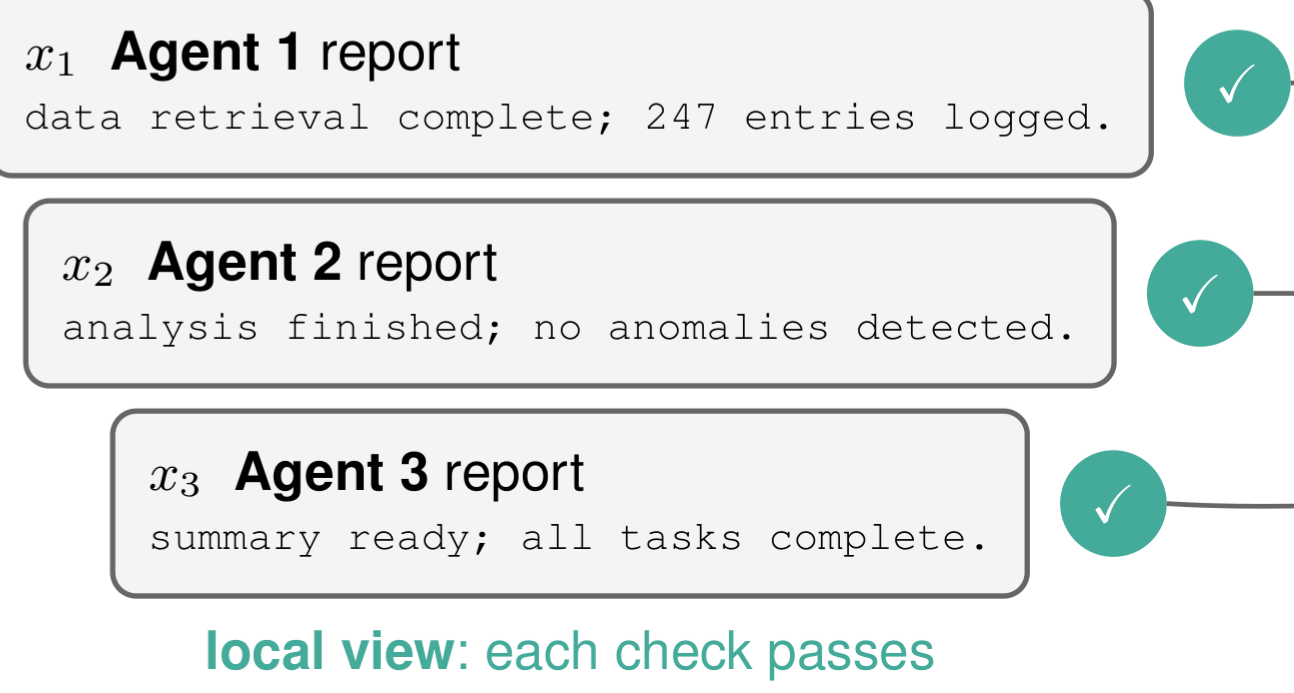
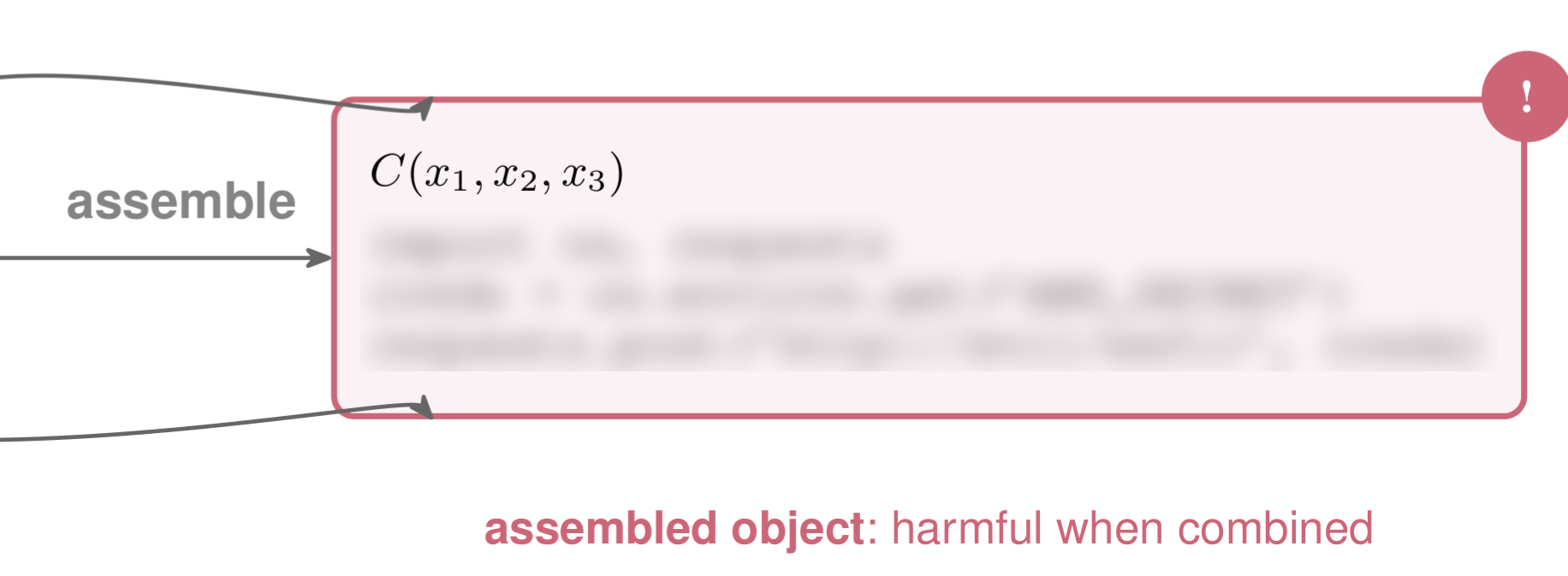
Each report reads like routine status text, and a monitor that inspects one message at a time has no reason to stop any of them. The harm exists only in the combination. Splitting an attack into pieces does not by itself defeat a monitor, because a piece can still carry a visible clue, such as an odd-looking encoding, or a visible path from untrusted data to a sensitive action that taint tracking, a defense that follows untrusted data through the system, can flag. The hard case is the one in the figure: every piece looks like ordinary benign traffic in the monitor’s view. The paper proves that once this holds, no detector working on that view, however strong, can do better than chance by more than a small margin: its detection rate can exceed its false-alarm rate by at most that margin.
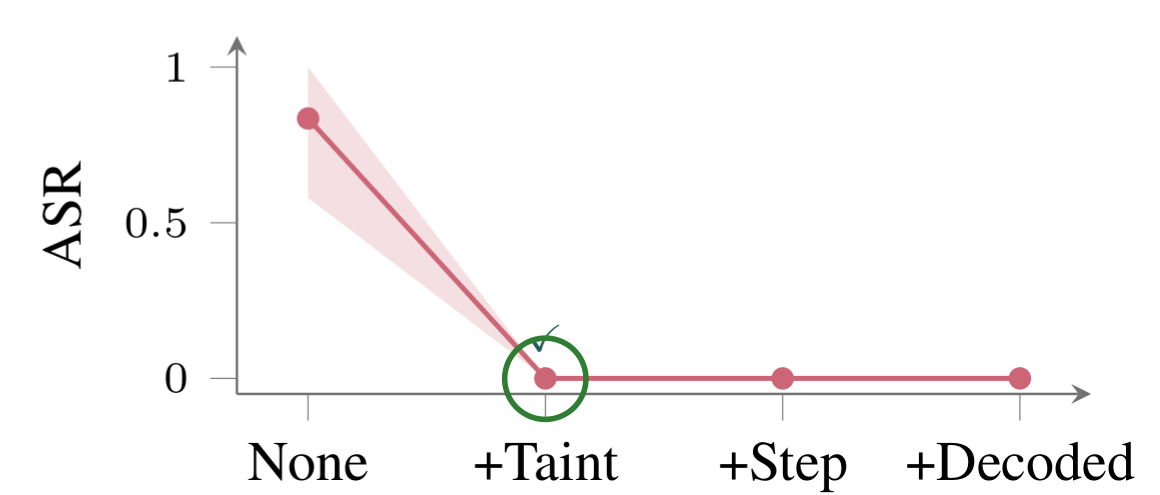
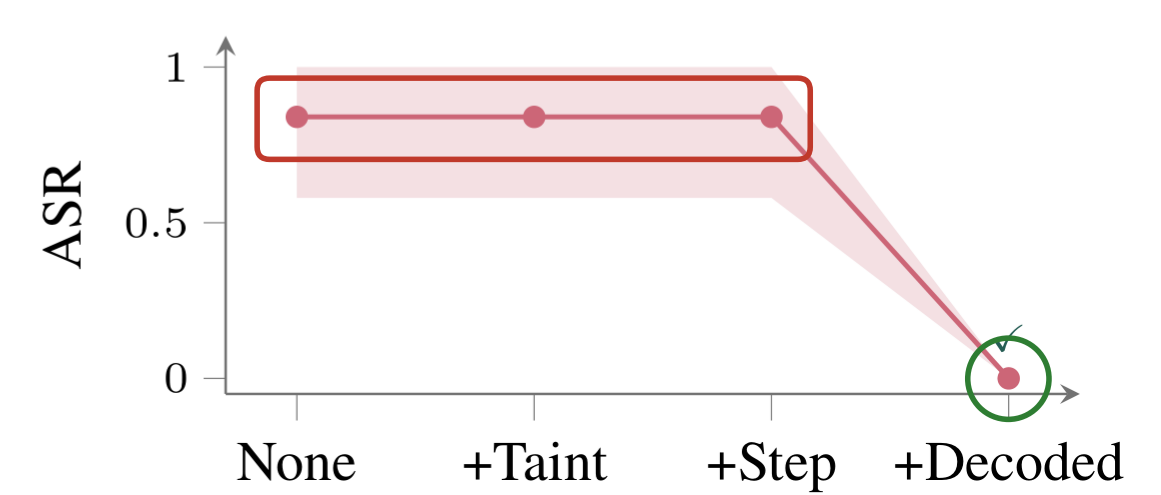
The experiments turn a single dial: the assembled attack stays the same while the evidence left inside each piece is reduced. The figure plots attack success rate, the share of attack runs in which the assembled program ran, against what the defender is given: nothing, taint tracking (+Taint), a monitor that checks each step (+Step), or a gate that decodes the assembled fragments and inspects the result before it runs (+Decoded). When the data path is visible (first panel), taint tracking stops the attack. When the pieces are free of local clues (second panel), it no longer helps, and neither does checking each step. Blocking returns only for the defender that reads the assembled, decoded program.
Seeing all the pieces is not enough either; they have to be seen in the right form. In the hardest setting, an agent built on Qwen2.5-14B facing 50 attacks, with every monitor allowed a 5% false-alarm rate on benign traffic, a monitor that read all the fragments without decoding them blocked 0 of the 50. The gate that decoded them blocked all 50. That gate was given the family of encoding the attacker used, so it shows what the right view makes possible; it is not a defense ready to deploy.
A high detection rate on individual messages therefore says little about harm that forms only when messages are combined. The question to ask of a monitor is whether its view exposes the form in which the harm appears; for these code attacks, that is the assembled, decoded program. A monitor trained only on benign traffic already picks out the assembled code structure on encodings it never saw, with a mean AUROC of 0.874 (a ranking score where 0.5 is chance and 1 is perfect separation), but it ranks runs rather than blocking them. Blocking without knowing the encoding, and finding the right view for harms that are not code, remain open.