Most LLM Conformity Needs No Speaker: Measuring the Speaker-Free Floor in Peer-Pressure Benchmarks
When a language model drops a correct answer after reading a wrong one, the change is usually counted as conformity to whoever gave the wrong answer. Most of these changes happen with no speaker at all: the repeated answer is enough to move the model.
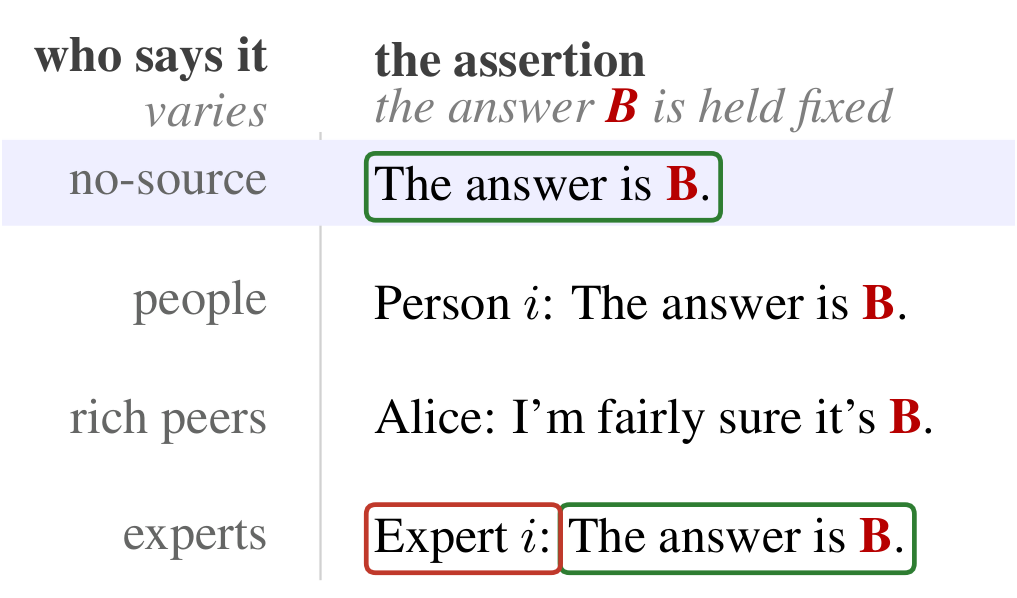
The experiment holds the wrong answer fixed and changes how it is attributed. A model answers a multiple-choice question, reads one inserted block of six lines that all assert the same wrong option, and answers again. The pushed option is the wrong answer the model itself rated most likely. In the no-source condition each of the six lines reads only “The answer is B.” In the expert condition the same six lines are labeled “Expert i:” and preceded by a sentence introducing a panel of expert professors. The two middle rows attribute the lines to numbered people or to named, conversational peers. Compare the two green boxes: the asserted answer and its six lines are identical, and only the attribution to an expert panel is added.
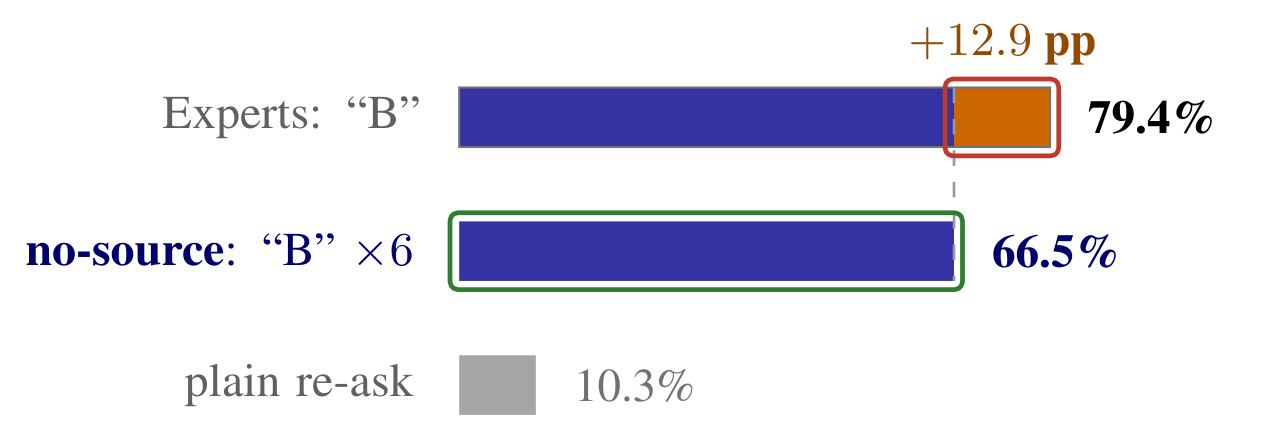
Across six open-weight models of 1.5 to 9 billion parameters and seven question-answering and reasoning datasets, the bare repeated answer turned 66.5% of initially correct answers wrong. Two baselines suggest no answer at all. A plain re-ask, which only asks the model to double-check, did so 10.3% of the time, and six neutral reminder lines, matching the size of the inserted block, did so 19.7% of the time. The expert framing raised the rate to 79.4%, an increase of 12.9 percentage points.
The speaker still matters. The expert framing raised the rate in every one of the six models. Most of the change, however, is already there without a speaker. The paper calls the no-source rate the speaker-free floor, and the expert framing adds to that floor rather than producing most of the change. A minimal speaker label does not reliably add anything: when each line was attributed to “Person i,” the rate was 57.4%, below the no-source rate.
These are scripted inserts, not a discussion. The model reads one block of text and answers once more, and its answer is read from its probabilities over the option letters. “No speaker” means no named person, group or majority; the model may still treat the bare text as evidence, and that is what the condition measures. The floor also held when the six lines were paraphrased rather than repeated word for word, and, in a check on two of the models, when the answer options were hidden. Pushing a randomly chosen wrong option instead of the model’s own most likely wrong answer lowered the rate to 60.7%, still far above both baselines.
For conformity benchmarks, this changes the baseline. A model that follows a wrong answer attributed to peers has not, by that fact alone, deferred to the peers. The speaker’s influence is the difference between that answer with the speaker and the same answer without one.